
 EN
EN FR
FRFrom Grasshopper to the World Stage
by Luke Penner
Some kids grow up on a farm, I grew up at an airport. My parents started Harv’s Air in 1972, and what began as my dad, one instructor, and one airplane has grown into more than forty instructors and nearly forty airplanes. Even with that kind of immersion in aviation: flight school life, aviation museums, and yearly pilgrimages to Oshkosh—I never believed flying was something I could actually achieve. I wasn’t a strong student in middle or high school, especially in math, and with both my dad and my oldest brother, Adam, being well-known instructors and pilot examiners, I found the whole world intimidating. For fear of failing, I buried any real interest in aviation.
That lasted until I was 21. By then, we had a 1943 Taylorcraft L-2M, “Grasshopper”, a pure, joyful little tube-and-fabric taildragger with a Continental O-170 making all of 65 horsepower. My dad offered me a no-strings-attached flight in C-GCER one spring day in 2003, and everything changed. I was so absorbed by the freedom and purity of flight that I forgot to feel unworthy or “not smart enough.” I soloed that little airplane in about seven hours, and my world opened up in ways I couldn’t have imagined.
I owe my aviation career to my parents, but I blame my dad enthusiastically for my aerobatics obsession. After I passed my PPL flight test, he took me for a celebratory flight in our Pitts S-2B, an airplane I’d always viewed as mythical, something only God-like pilots could handle. The figures he flew were spectacular, but what struck me most was how relaxed he was. We were vertical, inverted, doing everything in between, and he was singing. I wanted whatever it was that allowed a pilot to be that comfortable in every attitude. I’d felt nervous during stalls, steep turns, and spins in my training, and aerobatics suddenly felt like the doorway to understanding.
Throughout my CPL training, I gravitated toward aerobatics. After a basic 10-hour course in a Citabria, I spent countless hours practising on my own, eventually taking friends up and sharing the experience. That’s when things really ignited, seeing someone experience aerobatics for the first time is contagious.
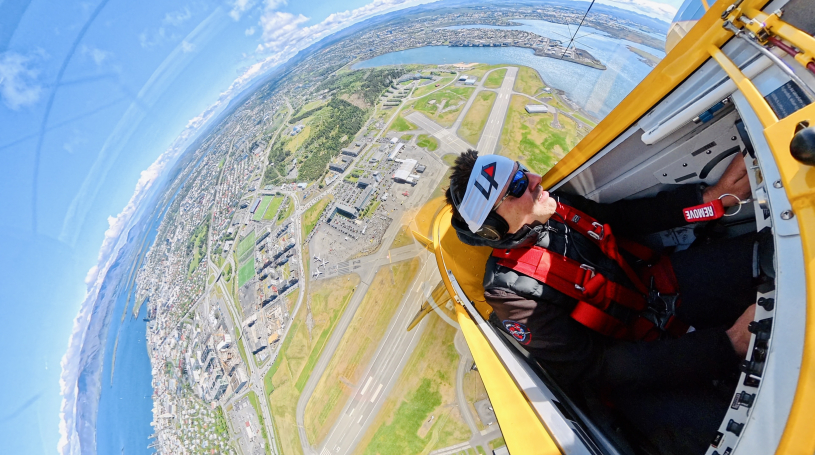
If you’d told me then that I’d one day be flying an Extra 330SC, the greatest aerobatic aircraft ever made in my opinion, or preparing to compete at the World Aerobatic Championship as captain of the Canadian team, I wouldn’t have believed you. This journey has been over twenty years in the making, and dedicating myself to mastering this art form has opened doors I never saw coming.
Practically, once I finished my CPL and instructor rating, I earned my checkout to solo the Pitts S-2B and, soon after, my Class 2 aerobatic instructor rating. Within a couple of years, I upgraded to both Class 1 instructor and Class 1 aerobatic instructor. I built a foundation teaching the basics, then travelled across the U.S. to schools with more advanced programs, where I learned flat spins, inverted spins, gyroscopic tumbles, torque rolls, and more. I also flew Pitts “Ride of Your Life” flights, always emphasizing precision. I’d ask passengers which heading they wanted to recover on from an inverted flat spin, a small detail that served me well when I entered my first competition in 2016. Nearly ten years and roughly forty contests later, I’ve flown every category from Primary to Unlimited.
Mental preparation is the defining factor in competition success. We all hear about “getting in the zone,” and in aerobatics it’s everything. I’ve made my share of crucial mistakes over the years, but I’ve treated each one as a lesson, not a defeat. The biggest takeaway is how much preparation it takes to avoid stumbling when it counts: hours of pre-visualization, studying winds to understand how they’ll shape presentation, and physically walking sequences on the ground, the “Aresti dance.” For me, the key is being intensely focused but relaxed. One strategy that’s helped is focusing on what I want to do in the cockpit, not what I’m trying to avoid. It keeps my mind in the right place.
Pre-visualization is just as valuable in everyday GA flying. I have my students walk the circuit on the ground before getting in the airplane. If your mind is already behind on the ground, it won’t magically catch up in the air. Preparation is everything.
For anyone who’s caught the aerobatic bug, the most important thing is to find a mentor. The aerobatic world can feel nebulous, and guidance from someone with a deep background, as an instructor, airshow pilot, or competitor, makes a huge difference. I enjoy being that resource, and people often reach out to me on Instagram (@harvsairinverted) with questions. Some of the best first steps are completing a basic 10-hour aerobatic course, joining both the International Aerobatic Club and Aerobatics Canada, and volunteering or simply hanging out at contests in Alberta, Manitoba, or Ontario.
If there’s one takeaway for pilots of all experience levels, it’s this: never stop challenging yourself. Beyond licensing requirements, flight hours mean very little. What matters is what you do with them. I’ve flown with 150-hour pilots who demonstrated better airmanship and decision-making than some 2,000-hour pilots, and I’ve flown with 10,000-hour pilots who constantly push themselves and display outstanding skill. The pilots I respect most are humble and open to learning. In aerobatics, coaching, and accepting criticism, is the only path to success.
One of my heroes, Rob Holland, who we sadly lost earlier this year, embodied that mindset. He was essentially the Wayne Gretzky of aerobatics, yet he was always accessible and always willing to help. I strive to follow his example, to pass on what I’ve learned so others can draw more skill, more satisfaction, and more safety from their flying.
Aviation has given me a lifetime of challenge, community, and joy. I hope to help others find the same.